Overview
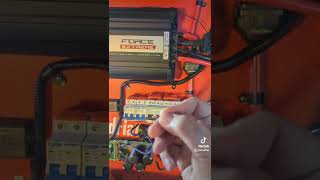
When you connect a car audio amplifier directly to a 12V power source, especially a high-capacity lithium battery, you may notice a visible spark at the moment of connection. This spark is not just a cosmetic nuisance; it is a symptom of inrush current, a brief but intense surge of electrical current that can stress or damage internal amplifier components. This article explains what inrush current is, why it occurs in car amplifiers, and how to safely prevent it.
What Is Inrush Current?
Inrush current is the large, instantaneous surge of current that flows into a device at the moment power is first applied. In car audio amplifiers, this surge occurs because the amplifier's internal power supply contains filter capacitors, often a large bank of them in 12V amplifiers, that are completely discharged before the amplifier is connected.
When the amplifier is connected to the 12V bus, those capacitors behave like a short circuit for a brief instant, drawing as much current as the source can deliver in order to charge up as quickly as possible. This produces:
- A visible spark at the connection point
- A sharp, high-amplitude current spike through the power wiring and internal components
- Mechanical and electrical stress on the capacitors themselves The higher the capacitance inside the amplifier and the lower the source impedance (i.e., the more capable the battery), the more severe the inrush event.
Why It Matters: Risk to Amplifier Components
The capacitors inside a car amplifier serve a critical function: they stabilize the internal supply voltage, which is then boosted by the amplifier's switching power supply to over 100V for the output stage. These capacitors are rated for a specific maximum charge rate and peak current.
A severe inrush event can:
- Stress electrolytic capacitors, reducing their lifespan or causing immediate failure
- Damage internal rectifiers or FETs in the power supply section
- Cause premature failure in amplifiers that are otherwise in good working condition This risk is especially pronounced when connecting an amplifier to a lithium battery, which has a very low internal resistance and can deliver an extremely high peak current, far more than a traditional lead-acid battery in the same situation.
⚠️ Important: Connecting an older amplifier directly to a lithium battery without inrush protection is particularly risky. The low internal resistance of lithium cells means the inrush current spike can be significantly higher than the amplifier's capacitors were designed to handle.
How to Prevent Inrush Current: The Pre-Charge Resistor Method
The simplest and most cost-effective solution is to use a pre-charge resistor: a plain resistor temporarily placed in series with the power connection before the final hard connection is made.
How It Works
A resistor limits the rate at which current can flow into the capacitors. Instead of the capacitors charging instantaneously (causing a spike), the resistor forces them to charge gradually over a short period. Once the capacitors are fully charged, the inrush event is over and the resistor can be bypassed or removed for normal operation.
Procedure
- Calculate an appropriate resistance value. The resistor must be large enough to meaningfully limit peak inrush current, but the exact value depends on the total capacitance inside the amplifier and the acceptable charge time. A few ohms to tens of ohms is a typical starting range for 12V amplifier pre-charging.
- Connect the resistor in series with the negative (or positive) power lead before making the final connection to the battery or power bus.
- Allow a brief moment for the internal capacitors to charge through the resistor. You will know charging is complete when the voltage across the resistor drops to near zero (measurable with a multimeter) or after a few seconds in most cases.
- Make the direct (bypassed) connection: remove the resistor and complete the permanent power connection normally.
Cost and Availability
Pre-charge resistors are inexpensive passive components available at any electronics parts retailer. The key is selecting a resistor with an appropriate resistance value and sufficient power rating to handle the brief surge without burning out during the pre-charge cycle.
Summary
| Concept | Detail |
|---|---|
| Cause of inrush current | Uncharged internal filter capacitors drawing maximum current at power-on |
| Visible symptom | Spark at the point of connection |
| Primary risk | Stress or failure of internal electrolytic capacitors |
| Highest-risk scenario | Connecting directly to a low-impedance lithium battery |
| Recommended prevention | Pre-charge resistor in series with the power lead before final connection |
Taking a few extra seconds to pre-charge your amplifier's capacitors before making a permanent connection is a simple habit that can meaningfully extend the life of your equipment, particularly in high-performance builds where lithium batteries are involved.