
Overview
Neodymium magnets are widely used in high-performance subwoofer motors because of their exceptional strength-to-size ratio. A common concern among car audio enthusiasts is whether pushing a subwoofer hard enough to overheat the voice coil will also permanently degrade the neodymium magnet's motor force. This article explains the physics behind neodymium heat sensitivity, what real-world testing shows, and what it means for subwoofer reliability.
How Heat Affects Neodymium Magnets
Neodymium magnets are known to lose magnetic strength when exposed to elevated temperatures. The rate of loss depends on the grade of the neodymium magnet, but as a general figure:
- Neodymium loses approximately 0.12% of its magnetic strength per degree Celsius of temperature rise above ambient.
- Heating the magnet by about 100°C above ambient (roughly 120°C) corresponds to a reversible loss of about 12% of motor strength while the magnet is hot. Most N42 to N52 grades cannot operate safely much above this without crossing into permanent-loss territory. This is a reversible, temperature-dependent effect, meaning the magnet is weaker while hot. The more important question for subwoofer users is: once the magnet cools back down, is that strength loss permanent?
Significant permanent (irreversible) demagnetization begins when the magnet is heated above its maximum operating temperature, which is typically 80°C to 200°C depending on the grade. Above that point, some of the loss does not recover on cooling and can only be restored by re-magnetizing the assembly. The Curie temperature (310°C to 400°C for most neodymium grades) is a different, higher threshold at which the magnetic domain structure breaks down entirely; above the Curie point the magnet is permanently and irrecoverably demagnetized. In practice, a subwoofer's voice coil fails thermally well before either threshold is reached.
Real-World Test: Cooking a Voice Coil
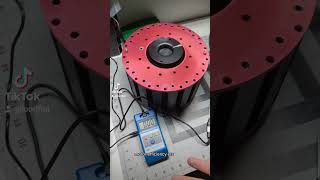
A controlled real-world test was conducted on a DD Audio Z4 15" subwoofer (a radial neodymium motor design) to determine whether severe thermal stress causes measurable permanent motor force loss.
Test Conditions
- The subwoofer was driven hard enough to cook the voice coil, producing visible smoke on the former
- After cooling, the motor's magnetic flux density was measured with a calibrated Gauss meter before and after the thermal event
Results
No measurable permanent loss in motor strength was detected after the voice coil failure event. The neodymium motor retained its full magnetic flux density once cooled, confirming that the thermal stress required to destroy a voice coil is not sufficient to permanently demagnetize the neodymium magnet assembly.
Neodymium vs. Ferrite: Magnetic Flux Density Compared
Understanding why neodymium motors are preferred in high-performance subwoofers requires understanding the difference in raw magnetic field strength between magnet types. Magnetic flux density is measured in Gauss (or milliTesla; multiply milliTesla by 10 to convert to Gauss).
A direct comparison using a Gauss meter on a standard ferrite subwoofer motor versus the DD Audio Z4's N52-grade neodymium motor illustrates the difference clearly:
| Motor Type | Measured Flux Density (approx.) |
|---|---|
| Standard ferrite motor | ~6,500 Gauss |
| DD Audio Z4 N52 neodymium motor | ~11,500 Gauss |
The N52-grade neodymium motor produces approximately twice the magnetic flux density of a comparable ferrite motor.
Why Flux Density Matters
Magnetic flux density in the voice-coil gap (B, measured in Tesla) is one of the two factors in the loudspeaker force factor BL, where L is the total length of voice-coil wire crossing that gap (in meters). BL determines how much force the motor produces per amp of current, and is a core determinant of motor efficiency. A stronger magnetic field in the gap means:
- More force per amp of current sent to the voice coil
- Higher motor efficiency: more of the electrical power delivered to the coil is converted to mechanical cone movement
- Greater output potential for a given power input This is why two subwoofers with identical power ratings can produce meaningfully different output levels: the one with the stronger motor converts power to motion more efficiently. Neodymium motors, particularly high-grade N52 designs, provide a significant efficiency advantage over ferrite motors at equivalent size and power levels.
Key Takeaways
- Neodymium magnets lose strength temporarily (reversibly) when heated below their maximum operating temperature, and recover fully on cooling. Heating above the maximum operating temperature (typically 80°C to 200°C depending on grade) starts to leave permanent loss that only re-magnetization can restore
- A subwoofer voice coil will fail thermally long before the neodymium magnet reaches a temperature that causes permanent demagnetization
- N52-grade neodymium motors (such as those used in the DD Audio Z4) produce approximately twice the magnetic flux density of standard ferrite motors (~11,500 Gauss vs. ~6,500 Gauss)
- Higher flux density translates directly to greater motor efficiency and output potential per watt of input power
Related Videos
What This Means in Practice
- While hot, a neodymium motor will experience a temporary reduction in motor force (up to ~12% at extreme temperatures). This is normal and expected physics.
- After cooling, motor force appears to fully recover, at least in the case of high-grade neodymium motors used in quality subwoofers, even after thermal stress severe enough to destroy the voice coil.
- The voice coil and former are the thermal weak points in a subwoofer, not the magnet. A coil will fail before the magnet suffers permanent damage under realistic operating conditions.
- This behavior may vary depending on the grade of neodymium used and the specific motor design. Results from one driver should not be assumed to apply universally to all neodymium subwoofers.
Important Caveats
This test represents a single data point on one specific driver. While the result is consistent with the physics of neodymium demagnetization (which requires reaching the Curie temperature, far above voice coil failure temperature), it should not be interpreted as a guarantee that all neodymium subwoofers will behave identically. Variables include:
- Neodymium magnet grade and Curie temperature rating
- Motor geometry and how heat is distributed through the assembly
- Duration and intensity of thermal exposure
- Whether the magnet itself (not just the coil) reaches critical temperatures in extreme cases
Summary
| Question | Answer |
|---|---|
| Do neodymium magnets lose strength when hot? | Yes, up to ~0.12% per °C above threshold |
| Is that loss permanent after cooling? | Not under typical subwoofer operating conditions |
| Can a subwoofer get hot enough to permanently damage the magnet? | Unlikely, the coil fails first |
| Should you intentionally overheat your subwoofer? | No, coil and former damage is still real and costly |