Overview
Ground loop isolators are one of the most commonly recommended quick fixes for alternator whine and other ground loop noise in car audio. Widely available at car audio retailers, they use an internal transformer to break the electrical ground connection between components. While they can eliminate ground loop noise, they introduce measurable signal degradation, including added harmonic distortion, injected noise, nonlinear frequency response, and gain shift. This article explains how they work, what the measured tradeoffs are, and what to consider before using one.
How a Ground Loop Isolator Works
A ground loop isolator is a passive inline device placed in the RCA signal path between a source (head unit, DSP) and an amplifier. Internally, it contains a small transformer: two coils of wire wound around a magnetic core. The audio signal is transferred from the input side to the output side via the magnetic field in the core, with no direct electrical connection between the two sides.
This galvanic isolation breaks the ground loop path: the two components are no longer electrically connected through the RCA shield, so any voltage difference between their ground references cannot circulate as current through the signal cable, which is what causes the audible hum or whine.
The tradeoff is that the transformer is a passive magnetic device with real-world limitations, and budget transformers have significant ones.
Measured Performance: What a Budget Isolator Actually Does to Your Signal
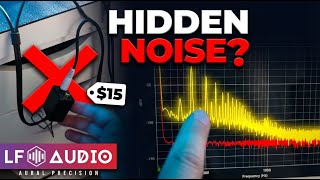
Testing a typical budget ground loop isolator (such as the commonly available DSN-1 style) against a direct RCA connection using a calibrated audio analyzer reveals several measurable problems.
1. Noise Injection
Rather than simply passing the signal cleanly, a budget isolator injects its own noise into the signal path. When a test tone is generated and measured through the isolator versus a direct RCA connection:
- The direct RCA path shows a clean signal at the test frequency with a quiet noise floor
- The isolator path shows the test tone plus significant spurious noise at harmonically related frequencies (40 Hz, 60 Hz, 100 Hz, and above) This is visible across the frequency spectrum: at 20 Hz, 500 Hz, and 2 kHz test tones, the isolator-equipped channel shows substantially elevated noise compared to the direct connection. In some cases, the noise injected by the isolator may be worse than the ground loop noise it was intended to fix.
2. Total Harmonic Distortion (THD) vs. Frequency
A full-spectrum THD sweep (20 Hz to 20 kHz) shows that a budget isolator's transformer introduces distortion that is frequency-dependent and worst at low frequencies:
| Frequency | Approximate THD (Budget Isolator) |
|---|---|
| 20 Hz | ~1.8% |
| 100 Hz | ~0.1% |
| 500 Hz | ~0.1% |
| 10 kHz | ~0.1% |
At 20 Hz, directly in the subwoofer passband, THD approaches 1.8%. For users primarily concerned with mid-bass or higher frequencies, the distortion figure may be acceptable. For subwoofer applications, this level of low-frequency distortion is significant.
The root cause is the transformer core: at low frequencies, the magnetic field must swing further to transfer the signal, and budget transformer cores saturate or behave nonlinearly at these excursions.
3. Nonlinear Frequency Response (Gain Variation)
A linearity sweep reveals that a budget isolator does not pass all frequencies at equal volume. Measured results show:
- At 20 Hz: approximately +1 dB of gain relative to the midrange
- The response becomes progressively less flat moving toward 20 kHz This means the isolator is not a transparent device: it changes the tonal balance of the signal passing through it. More importantly, it increases the signal level seen by the amplifier relative to what was present before the isolator was installed.
4. Gain Shift and Amplifier Re-Calibration
Because a budget isolator can add approximately 1 dB or more of gain at certain frequencies, amplifier gains must be re-set after installing one. If gains were calibrated with a direct RCA connection and a ground loop isolator is then added inline:
- The amplifier will see a higher input signal than it was calibrated for
- At maximum volume, the amplifier may clip earlier than expected
- Distortion and potential speaker damage can result Any time a ground loop isolator is added to an existing installation, amplifier gains must be rechecked and recalibrated.
Budget vs. Premium Isolators
The performance problems described above are characteristic of budget transformers. Higher-quality isolation transformers use superior core materials and winding techniques that result in:
- Lower THD across the frequency range
- Flatter frequency response (better linearity)
- Minimal phase shift
- Lower noise floor The performance difference is real and measurable. A premium isolation transformer commands a significant cost premium over a budget unit for a reason: designing a transformer that is linear, phase-accurate, and low-distortion across the full audio band requires significantly better materials and engineering.
When to Use a Ground Loop Isolator
A ground loop isolator is a last-resort tool, not a first step. Before reaching for one, the correct approach is to address the ground loop at its source:
- Ensure all components share a common, low-impedance ground point
- Verify the head unit or DSP chassis ground is clean and secure
- Check that RCA cables are routed away from power wiring
- Confirm the amplifier chassis ground is bonded to the same point as the source unit If a ground loop persists after proper grounding and routing, a ground loop isolator can provide relief, but users should understand the signal quality tradeoffs involved, particularly with budget units.
If signal quality is a priority and isolation is genuinely required (for example, in a high-voltage build where galvanic isolation is a safety requirement), a premium isolation transformer is the appropriate solution. See the related article on RCA Isolation Transformers: Magnetic Saturation and Voltage Limits for more detail on that application.
Summary
| Characteristic | Direct RCA | Budget Isolator | Premium Isolator |
|---|---|---|---|
| Ground loop elimination | No | Yes | Yes |
| Noise injection | Minimal | Significant | Minimal |
| THD at 20 Hz | Very low | ~1.8% | Very low |
| Frequency response linearity | Flat | Nonlinear (~1 dB variation) | Flat |
| Gain shift | None | ~+1 dB | Minimal |
| Requires gain recalibration | No | Yes | Minimal adjustment |