Overview
Passive RCA Y-splitters and repeater boxes are a popular way to feed multiple amplifiers from a single source output, but they introduce measurable low-frequency signal loss and phase shift that directly affects subwoofer performance. This article explains the electrical reason this happens, starting with the circuit built into every head unit and DSP, and what to use instead.
The Output Circuit Inside Your Head Unit or DSP
Before understanding what a passive splitter does to your signal, it helps to understand what is already happening inside your source unit. Every head unit and DSP has a small output circuit on its RCA preout that includes:
- A DC-blocking capacitor: Required to prevent any DC voltage from reaching the amplifier inputs. Typically around 4.7 µF in most designs.
- A series safety resistor: A low-value resistor (often around 40 Ω) placed in series with the output to prevent a short circuit if the RCA ends are accidentally touched together.
- A ground-reference resistor: A high-value resistor (often around 47 kΩ) that ties the signal rail to ground, providing a stable reference. On the receiving end, the amplifier's preamp input section presents its own input impedance, typically around 20 kΩ.
The RC Filter This Creates
The combination of the DC-blocking capacitor and the total resistance in the circuit forms an RC high-pass filter. This filter has a -3 dB point (the frequency at which the signal level drops by 3 dB) determined by:
f(-3dB) = 1 / (2π × R × C)
Where:
- R = the total load resistance seen by the source output
- C = the DC-blocking capacitor value This RC filter has two consequences that are always present to some degree, even with a single amplifier:
- Signal attenuation below the -3 dB point: the lower the frequency, the more the signal is reduced
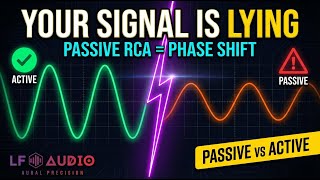
- Phase shift: the output signal's low-frequency content is phase-shifted relative to the input (positive phase shift that grows toward +90° well below the corner frequency). The shift is frequency-dependent, not a constant time delay across the band: bass content is rotated more than midrange. At 1 kHz with a typical single-amplifier load (~20 kΩ), both effects are minimal and largely inaudible. At 20 Hz, where subwoofers operate, the phase shift becomes measurable even in a single-amplifier setup.
The Problem with Passive Y-Splitters
When you connect a passive Y-splitter or repeater box to feed multiple amplifiers, their input impedances are placed in parallel. Parallel resistances reduce the total resistance seen by the source:
R_total = 1 / (1/R1 + 1/R2 + ... + 1/Rn)
Example: 20 amplifiers each with 20 kΩ input impedance connected in parallel:
R_total = 20,000 / 20 = 1,000 Ω (1 kΩ)
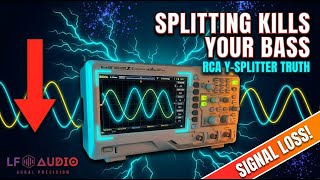
As the total resistance drops, the -3 dB frequency rises, meaning the RC filter now begins attenuating at a higher frequency, cutting directly into the subwoofer passband. Simultaneously, phase shift at low frequencies becomes dramatically worse.
Quantified Impact
With a total load of 1 kΩ (simulating 20 amplifiers in parallel) versus a single 20 kΩ amplifier load, circuit simulation at 20 Hz shows:
- Phase shift: Approaches ~90°, the signal reaching the amplifiers is nearly a quarter-cycle behind what the source is outputting
- Voltage attenuation: Approximately 50%, the amplifiers are receiving roughly half the signal voltage the source is generating This means that at 20 Hz, your amplifiers may be seeing half the intended signal level and a severe phase error, neither of which can be fully corrected by adjusting amplifier gain alone.
At higher frequencies (e.g., 1 kHz), the phase shift is much less pronounced, but some attenuation is still present. The effect is most damaging in the subwoofer range where phase accuracy and output level are critical.
Measured Results
Testing with a calibrated audio analyzer (frequency response sweep from 20 Hz to 200 Hz) comparing a single amplifier load versus four amplifiers in parallel through a passive splitter:
- Single amplifier: Signal is relatively flat through the subwoofer range, with gentle rolloff beginning near 100 Hz
- Four amplifiers in parallel (~5.5 kΩ total load): The -3 dB point moves up to approximately 30 Hz, directly in the middle of the subwoofer passband This means that at 20-30 Hz, the signal reaching your amplifiers through a passive Y-splitter is already significantly attenuated before the amplifier gain control is even considered.
Why This Matters for SPL Builds
In a competition SPL build or any system with multiple amplifiers, using passive distribution means:
- Gain compensation is required: You must increase amplifier gain to compensate for the attenuation, which also raises the noise floor
- Phase must be manually corrected: The low-frequency phase shift varies by frequency and load, making it difficult to correct with a fixed phase adjustment
- The source output stage is overloaded: Most head unit and DSP preout stages are designed to drive loads of 5 kΩ to 20 kΩ. Driving a 1 kΩ load (20 amps in parallel) forces the output stage to work far harder than intended, which can increase distortion or cause instability
The Solution: Active Buffering
An active RCA buffer, sometimes called a line driver, preamp buffer, or multi-amplifier synchronizer, places a unity-gain op-amp circuit between the source output and the amplifier inputs. Examples include the DD Audio ZVL, the LF Audio WVC, and similar devices.
How It Works
The buffer presents a high, fixed input impedance (typically ~20 kΩ) to the source at all times, regardless of how many amplifiers are connected downstream. The source always sees the same single load, so the RC filter behavior of the source's output circuit remains stable and predictable.
The buffer then drives each amplifier output independently through its own low-impedance output stage. Each amplifier still sees its normal input impedance, but the source is isolated from the parallel loading effect entirely.
What This Preserves
- Phase response: The source's RC filter operates at its designed operating point, keeping phase shift at low frequencies to the minimum inherent in the circuit design
- Signal voltage: No attenuation from parallel loading; each amplifier receives the full intended signal level
- Source output stage health: The source drives only the buffer's high-impedance input, not a low-impedance parallel combination of multiple amplifiers
What to Look For in an Active Buffer
- Low THD (Total Harmonic Distortion): The buffer's op-amp stage should add minimal distortion of its own
- Sufficient output channels: One buffered output per amplifier is ideal
- Unity gain: The buffer should reproduce the signal accurately without coloring it
Summary
| Condition | Phase Shift at 20 Hz | Signal Level |
|---|---|---|
| Single amplifier (20 kΩ load) | Minimal | Full |
| 4 amplifiers passive (5.5 kΩ load) | Moderate | -3 dB or more |
| 20 amplifiers passive (1 kΩ load) | ~90° | ~50% (-6 dB) |
| Active buffer (any number of amps) | Minimal (same as single amp) | Full |
Passive Y-splitters and repeater boxes are not a neutral signal distribution method. The more amplifiers you add in parallel, the worse the low-frequency phase shift and attenuation become, and these are exactly the frequencies where subwoofer performance is most sensitive. An active buffer eliminates the parallel loading problem entirely and is the correct solution for any multi-amplifier system.