Overview
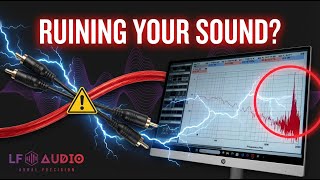
RCA cables used in car audio are susceptible to electromagnetic interference (EMI) from nearby power wires, speaker cables, and electrical devices. This article explains how EMI enters the RCA signal path, what factors make it worse, and what the measured evidence shows about cable length and routing.
How EMI Enters an RCA Signal Path
RCA (single-ended unbalanced) cables consist of two conductors: an outer shield that doubles as the signal return, and an inner conductor that carries the forward audio signal. The shield is not neutral: every audio current that flows out the inner conductor returns through the shield. In a vehicle, voltage drops along the chassis ground between head unit and amplifier appear directly on the shield (the classic ground-loop mechanism), and the inner conductor is additionally exposed to radiated electromagnetic interference from nearby sources.
Common EMI sources in a vehicle include:
- Power amplifier supply wiring
- Speaker cables running parallel to RCA runs
- Lithium battery banks and balancers
- CAN bus and vehicle computer activity
- Electric motor controllers and inverters When the inner conductor picks up this radiated noise, it is indistinguishable from the audio signal at that point in the circuit. The amplifier's preamp section will amplify both the desired signal and the noise together.
Cable Length: Why It Matters
A short RCA run in a controlled bench test shows minimal difference between a budget cable and a premium triple-shielded cable. The noise pickup is low regardless of shielding quality when the run is short.
However, as cable length increases to simulate a real vehicle installation, where an RCA may travel 10-20 feet from a head unit at the dash to amplifiers in the trunk, the opportunity for noise pickup increases significantly. Testing with long cables looped near a subwoofer power cable demonstrates that noise in the low-frequency range (below 100 Hz) becomes measurable and audible.
Key takeaways from cable length testing:
- Short runs: minimal EMI impact regardless of cable quality
- Long runs: EMI pickup increases; routing becomes more important
- Routing near power cables: amplifies the problem significantly; avoid running RCAs parallel to and in contact with power or speaker wiring
Cable Shielding: Does It Matter?
In short-run bench tests comparing a budget Amazon Basics cable against a triple-shielded premium cable, the measured noise pickup at low frequencies (below 100 Hz) is essentially identical. This suggests that for typical car audio installations, cable routing and length have a greater practical impact on EMI pickup than shielding quality alone.
This does not mean shielding is irrelevant. In extreme EMI environments or very long runs, better shielding may provide marginal benefit, but it should not be the first variable to optimize. Proper routing is more impactful.
Routing Best Practices
To minimize EMI pickup in a real installation:
- Run RCAs on the opposite side of the vehicle from power cables: Keep signal cables on one side of the car (e.g., passenger side) and power/ground cables on the other (e.g., driver side).
- Avoid running RCAs parallel to speaker cables: Speaker cables carry AC current that radiates EMI just as power cables do.
- Cross power and signal cables at 90°: If RCAs must cross a power run, cross them perpendicularly rather than running parallel.
- Keep runs as short as practical: Every additional foot of cable is additional antenna length.
- Avoid leaving long service loops near power or speaker cables: a coiled RCA that carries signal and return together has essentially zero loop area on its own; the real concern is proximity to noise sources. If you must coil excess, coil tightly (figure-8 if practical) and keep the bundle away from power runs.