
Overview
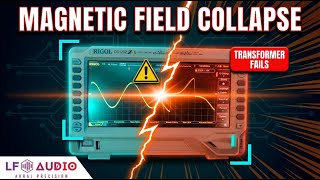
Magnetic RCA isolation transformers (also called RCA decoupling transformers) are used in car audio builds to break ground loops between components, particularly between a DSP and a high-voltage amplifier. While they solve real grounding and safety problems, they have a critical operating limit that is easy to overlook: magnetic saturation. If the input signal voltage exceeds the transformer's rated peak level, the transformer's magnetic field collapses and the output becomes severely distorted. This article explains what saturation is, how to identify it, and how to select the correct transformer for your signal chain.
Why Use an RCA Isolation Transformer?
In a high-voltage car audio build, for example one where a 400V DC bus amplifier is used, there is a risk of a ground loop forming between the DSP (which references the vehicle's 12V chassis ground) and the amplifier. Beyond noise, there is a more serious safety concern: if a component inside the amplifier shorts internally, the high-voltage potential (400V) can travel back through the RCA shield into the DSP and destroy it. This has been observed in real builds where a shorted amplifier sent 400V back through the RCA connection and blew up the DSP.
An RCA isolation transformer placed between the DSP output and the amplifier input provides galvanic isolation: the two sides of the transformer are magnetically coupled but not electrically connected. This eliminates the ground loop path and prevents high-voltage faults from propagating back into the DSP.
What Is Magnetic Saturation?
A transformer works by using a changing magnetic field in its core to transfer energy from the primary winding to the secondary winding. The core material can only support a magnetic field up to a certain strength, its saturation point. When the input signal drives the core beyond this limit:
- The core can no longer respond linearly to the input signal
- The core's incremental permeability collapses: it can no longer increase flux in proportion to the applied voltage. Primary inductance drops, magnetizing current surges, and the output waveform clips into severe distortion
- The transformer output becomes severely distorted, no longer a clean reproduction of the input waveform
- At higher input levels, the output may become essentially unusable noise Saturation is determined by the transformer's design: core material, core size, number of turns, and rated maximum input voltage. Every transformer has a published (or measurable) maximum input voltage above which saturation occurs.
How Saturation Manifests in Practice
Saturation does not always appear gradually. In real-world testing using an oscilloscope to monitor the transformer output while sweeping the input voltage upward:
- Below the saturation threshold, the output is a clean sine wave that tracks the input normally
- At the saturation threshold, for example approximately 1 volt peak on a standard line-level transformer, the output waveform abruptly collapses into distortion
- Above that threshold, the output continues to degrade further as input voltage increases This behavior can be confirmed with a sine wave sweep on an oscilloscope. However, a sine wave sweep alone is not sufficient to validate a transformer for music playback. Music is a complex signal with many simultaneous frequencies, and the instantaneous peak voltages produced by real program material can be significantly higher than a steady-state sine wave at the same RMS level. A transformer that passes a sine wave sweep cleanly may still saturate on music transients.
Identifying the Problem by Symptom
If an RCA isolation transformer is saturating in your system, you may observe:
- Reduced output power: the amplifier is not receiving a clean, full-level signal
- Audible distortion at higher volumes: a loud, harsh noise that appears at a specific volume threshold
- Clipping-like behavior: the system sounds like it is clipping even when the DSP and amplifier gain structure appear correct
- Inconsistency between test tones and music: the system may measure acceptably with a sine wave but distort badly on bass-heavy program material These symptoms can be mistaken for amplifier clipping, gain structure problems, or DSP misconfiguration. Placing an oscilloscope on the RCA output of the transformer (the signal going into the amplifier) while playing music will reveal whether the waveform is collapsing.
Transformer Ratings: What to Look For
Line-Level vs. High-Output Transformers
Standard line-level RCA isolation transformers are designed for typical consumer audio signal levels, generally 1 volt peak or less. A DSP or head unit with a 3-4 volt RMS maximum output will drive these transformers well into saturation.
When selecting an isolation transformer for a car audio signal chain, verify the following specifications:
| Specification | What to Look For |
|---|---|
| Maximum input level | Must exceed the peak output of your source (DSP, head unit, line driver) |
| THD at rated level | Lower is better; 0.01% or less at 20 Hz is a good benchmark |
| Frequency response | Should be flat through the subwoofer range (20 Hz and above) |
| dBV rating | A rating of +18 dBV (approximately 7.9 V RMS, ~11.2 V peak, ~22.4 V peak-to-peak) is appropriate for high-output DSP preouts |
Why Low-Frequency Performance Matters
Transformers are harder to design for low frequencies. At 20 Hz, the magnetic field must sustain itself through a much longer half-cycle than at 1 kHz. This is why transformer THD specifications are typically measured at 20 Hz: it is the worst-case operating condition. A transformer rated at 0.01% THD at 20 Hz will perform well across the entire audio band.
Selecting a Replacement Transformer
If your existing isolation transformer is saturating, the solution is to replace it with one rated for the actual signal levels in your system. As a practical example:
- A DSP with a 3.5V RMS maximum output produces approximately 5V peak on a sine wave, and higher instantaneous peaks on complex program material
- A transformer rated for +18 dBV (approximately 7.9 V RMS, ~11.2 V peak) provides comfortable headroom for this source
- Jensen Transformers and similar professional-grade manufacturers produce subwoofer-specific isolation transformers with appropriate low-frequency headroom and very low THD
Temporary Workaround: Reducing DSP Output Level
If a replacement transformer is not immediately available, the system can be operated at a reduced DSP output level to stay below the saturation threshold. However, this comes with a significant penalty:
- A transformer that saturates at 1 V peak, used with a DSP capable of ~5 V peak (3.5 V RMS), forces the DSP to operate at roughly one-fifth of its rated output voltage (a loss of about 14 dB of usable level)
- This dramatically reduces the signal level reaching the amplifier, limiting available output power
- It also worsens the signal-to-noise ratio, as the amplifier gain must be increased to compensate for the lower input level This workaround is acceptable as a short-term measure but should not be treated as a permanent solution.
Summary
| Topic | Key Point |
|---|---|
| Purpose of isolation transformer | Breaks ground loops; prevents high-voltage faults from reaching DSP |
| Saturation | Occurs when input voltage exceeds transformer's magnetic capacity; output collapses |
| Saturation threshold | Varies by transformer; standard line-level units typically saturate at ~1V peak |
| Music vs. sine wave | Music produces higher instantaneous peaks; a transformer that passes a sine sweep may still saturate on program material |
| Correct transformer rating | Must exceed the peak output of the source; +18 dBV rated units are appropriate for high-output DSPs |
| Key spec to check | THD at 20 Hz; maximum input level in dBV |
Related Videos
Identifying Saturation on an Oscilloscope
Saturation is easy to identify with an oscilloscope connected to the transformer output:
- Clean signal: The output waveform is a smooth sine wave that closely mirrors the input.
- Saturated signal: The waveform flattens, clips asymmetrically, or collapses into a distorted shape that no longer resembles a sine wave. The distortion worsens as input voltage increases. A practical test is to sweep the input voltage upward while monitoring the output waveform at a low test frequency (e.g., 25 Hz). The point at which the waveform begins to deform is the transformer's effective saturation threshold at that frequency.
Budget vs. High-Quality Transformers: A Practical Comparison
Generic budget ground loop isolators typically use small, low-grade transformer cores optimized for cost rather than low-frequency linearity. When tested at 25 Hz with a signal voltage representative of a high-output line driver or DSP:
- Budget transformer: Waveform begins to distort at relatively low voltages (as low as ~2-3V peak). Increasing the signal further causes the waveform to collapse entirely. At 5V peak, the output may be unrecognizable as a sine wave.
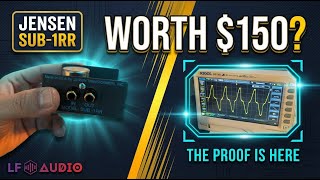
- High-quality transformer (e.g., Jensen Transformers Sub-1RR / Isomax): Maintains a clean, undistorted sine wave well beyond the voltage levels a typical line driver or DSP can produce. Oscilloscope testing confirms clean output at 5.5V peak (11V peak-to-peak), the full output capability of a high-output line driver, with no visible saturation artifacts. The Jensen Sub-1RR is rated for 18 dBV input, which corresponds to approximately 7.9V RMS. Its specified THD is 0.001% at 20 Hz, an order of magnitude better than typical budget isolators. This makes it suitable for subwoofer-only applications where signal integrity at the lowest audible frequencies is critical.
Voltage Rating and Signal Chain Compatibility
When selecting an isolation transformer for a high-voltage amplifier build, the transformer's maximum input voltage rating must exceed the peak output of your signal source. Key considerations:
- Identify your source's maximum output voltage: A high-output line driver may produce 11V peak-to-peak (5.5V peak / ~3.9V RMS) or more. Some DSPs with boosted outputs can exceed this.
- Match the transformer's rated input to your source: The transformer's rated maximum input (in dBV or Vrms) must comfortably exceed the source's maximum output, including any headroom for transient peaks.
- Low-frequency performance matters most for subwoofers: Always verify the THD specification at 20 Hz, not just at 1 kHz. A transformer that measures well at 1 kHz may still saturate at 20 Hz.
- DSP output limiting as a safeguard: Even with a high-quality transformer, setting the DSP's output level so that normal program material never approaches the transformer's saturation threshold provides an additional margin of safety. An oscilloscope can be used to verify the maximum real-world signal level under heavy bass content.