Overview
A common shortcut when feeding a mono subwoofer amplifier from a stereo source is to plug both the left and right RCA outputs into one Y-cable so the two signals "combine" into a single mono feed. This works on a wiring diagram, but electrically it is not a sum: it is a short between two op-amp outputs. The result is a distorted signal, increased output stage current, and in some cases long-term thermal stress on the source unit. This article explains what is actually happening on that wire, why it does not produce true summing, and the two correct ways to combine left and right into a mono feed.
A Y-splitter used to feed multiple amplifiers from a single output (one source, many loads) is a different topology. The problem covered here is the opposite direction: using a Y to merge two source outputs into one input.
What Summing Should Actually Do
For a clean mono feed, the combined signal needs to follow simple arithmetic:
V_mono = (V_L + V_R) / 2
This produces a signal that:
- Reproduces material panned to the center at full level
- Reproduces material panned hard left or hard right at half level
- Cancels signal that is exactly anti-phase between channels (correct behavior; these are typically reverb tails or stereo widening effects, and a mono sub should not reproduce them)
- Stays linear with input level: doubling both channels doubles the output
Any topology that does not produce this relationship is not summing. It is producing a different, level-dependent voltage that depends on the electrical characteristics of whatever is driving each side.
Inside an RCA Output: A Voltage Source, Not a Signal Mixer
Every head unit, DSP, and active line driver presents its RCA preouts as op-amp voltage sources. Each output behaves like an ideal voltage generator with a very low output impedance, typically less than 100 Ω, often less than 10 Ω after the small series safety resistor (commonly ~40 Ω) inside the unit.
A voltage source has one job: drive the wire to the voltage it is told to drive. If the voltage at the output node disagrees with the op-amp's target, the op-amp will increase output current to force the node to match.
This is the assumption every RCA output stage is built around: only one driver per node.
What a Y-Cable Actually Does
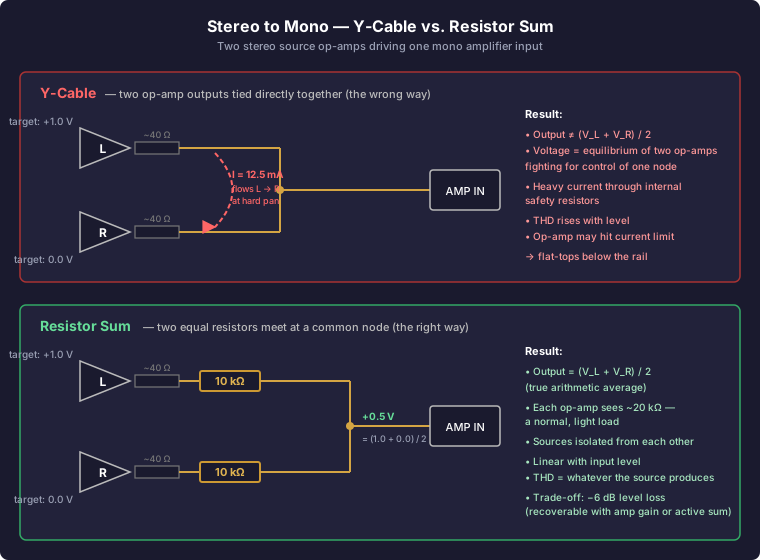
When two op-amp outputs are tied together with a Y-cable, both op-amps are now trying to control the same node simultaneously. Consider a moment when the music is panned hard left:
- Left channel target: +1.0 V
- Right channel target: 0.0 V
Each op-amp drives toward its target through its internal series resistance (call it R_out, ~40 Ω):
I = (V_L - V_R) / (R_out_L + R_out_R)
I = 1.0 V / 80 Ω
I = 12.5 mA
That 12.5 mA flows continuously between the two outputs (left sourcing it, right sinking it) for as long as the two channels disagree. The actual voltage on the wire settles at roughly the midpoint of the two op-amp targets, weighted by their relative output impedances.
The further apart the two channels are, the more current flows. On a stereo source playing material with hard panning or anti-phase content, this current is constant and substantial.
Why This Is Not Summing
The voltage that ends up on the cable is not (V_L + V_R) / 2. It is the equilibrium point where the two op-amps' sourcing and sinking currents balance, which depends on:
- Each op-amp's instantaneous output impedance (which varies with output voltage, current, and temperature)
- Each op-amp's short-circuit current limit (typically 25-40 mA for common audio op-amps)
- Any DC offset mismatch between the two channels (forces continuous current even with no signal)
The relationship to the input is non-linear and asymmetric. It approximates a sum at low signal levels and small channel differences, then degrades as either grows.
How This Overdrives the Output Stage
Most audio op-amps used in head unit and DSP preouts (4558, NE5532, OPA1652, etc.) are specified to drive loads of 2 kΩ or higher while meeting their published distortion numbers. A Y-cable presents the source op-amp with an effective load equal to the other op-amp's output impedance: somewhere between 10 Ω and 80 Ω depending on the design.
That is roughly 25 to 200 times heavier than the op-amp was designed for.
Three things happen as a result:
- THD rises sharply. The op-amp's open-loop gain falls off at high output current, and feedback can no longer correct distortion as effectively.
- The internal current limit may engage. When the op-amp hits its short-circuit current ceiling, the output flat-tops in a way that looks like clipping but happens well below the rail voltage.
- The output transistors heat up. Continuous current into a near-short raises die temperature, accelerating long-term degradation and in extreme cases triggering thermal shutdown of the IC.
The series safety resistor inside the source (the ~40 Ω part) is what prevents immediate damage from this misuse. It is not a signal-conditioning element. Do not assume the manufacturer "designed for it": they designed for a momentary short, not for continuous Y-cable summing across a 30-minute song queue.
Symptoms You Can Hear and Measure
A system using a Y-cable to sum stereo into a mono subwoofer feed typically shows:
- Center-panned bass at the wrong level relative to side-panned bass: because the topology is not a real average
- Audible intermodulation distortion during dense passages
- Crosstalk between channels in the stereo mids and highs if the same source feeds both stereo and sub amps from a shared Y-junction
- Higher noise floor if the source's automatic gain control or output buffer is reacting to the loading
- Rising THD with level, measurable on an audio analyzer: clean output at low volume, increasingly distorted output as the music gets louder
These symptoms are usually blamed on the subwoofer amplifier or speaker, but the signal arriving at the amplifier input is already broken.
The Right Way: Passive Resistor Summing
The simplest correct way to combine two RCA channels uses two equal resistors meeting at a common node:
V_L ──[ R ]──┐
             ├──> V_mono
V_R ──[ R ]──┘
With R = 10 kΩ for both resistors and an amplifier input impedance of ~20 kΩ:
- Each op-amp now sees an easy ~20 kΩ load (its summing resistor in series with the parallel of the other resistor and the amp input)
- The output node voltage is approximately (V_L + V_R) / 2: a true arithmetic average
- The two source outputs are isolated from each other; neither is driving the other
What This Costs
- -6 dB of signal level, because passive resistor summing is also a 2:1 voltage divider. This is unavoidable in any passive sum and must be made up with amplifier gain.
- Slight loss of high-frequency response if cable capacitance is high and the resistors are very large: keep R between 1 kΩ and 22 kΩ for normal RCA cable lengths.
What This Buys
- The source op-amps are no longer fighting each other
- Distortion drops to whatever the source produces on its own
- The summed signal scales linearly with input level, with no current-limit clipping
This is the topology used inside virtually every passive "stereo-to-mono" RCA adapter sold for car audio that is not just a Y-splitter.
The Better Way: Active Summing
An active summing circuit uses an op-amp configured as an inverting summer. Each input goes through its own resistor to the inverting input (a virtual ground), and a single feedback resistor sets the gain:
- Recovers the level lost by passive summing: typically configured so V_mono = V_L + V_R, which restores the original level for a center-panned signal (and produces +6 dB for fully correlated inputs), or set to an intentional gain via the feedback resistor ratio
- Presents a high, fixed input impedance to each source (~10-20 kΩ): the source op-amps see a normal load, not each other
- Provides a low-impedance buffered output that can drive long RCA runs and parallel amplifier inputs without further loss
This is what active line drivers, mono summing buffers, and DSP input stages do internally. Any product with an "L+R to MONO" feature that is not just a passive resistor network is doing exactly this.
When You Actually Need a Summed Mono Feed
The above only matters if your source does not already provide one. Most modern head units and DSPs have a dedicated mono subwoofer output that is summed correctly inside the unit, often with its own low-pass filter, gain control, and phase switch. Use that output if it exists. The summing has already been done properly upstream.
Cases where external summing is justified:
- The source has only stereo preouts and you need to feed a single mono amplifier
- A line driver, EQ, or crossover you want to install has a mono input but no built-in summer
- You are bridging a channel or doing a custom signal path where the source's internal sub output is not available
In those cases, use a passive resistor adapter or an active summing buffer, never a Y-cable.
Summary
| Topology | Loads on Source Op-Amp | Linear Sum? | Signal Level | THD Penalty |
|---|---|---|---|---|
| Y-cable (two outputs tied together) | 10-80 Ω (effectively a short) | No, depends on op-amp current limits | Indeterminate | Severe, level-dependent |
| Passive resistor summer (2x 10 kΩ) | ~20 kΩ (normal) | Yes | -6 dB | None added by the summer |
| Active summing buffer | ~10-20 kΩ (normal) | Yes | Adjustable, typically unity | Op-amp THD only (very low) |
A Y-cable is a wiring convenience, not a signal-processing tool. It works as a splitter because one source can drive many high-impedance inputs in parallel without harm. It fails as a summer because two voltage sources cannot share a wire without fighting. If your source does not already give you a proper mono sub output, sum the channels through resistors (passive or active) and never tie two op-amp outputs directly together.